Minister of Economy and Tourism and Chairman of the Board of Directors of 'Majra' – the National Community Responsibility Fund, Abdullah bin Touq Al Marri, announced the launch of the 'UAE Companies for Good 2031' strategy. This strategy serves as a comprehensive national framework to enhance the private sector's contributions to sustainable development and guide its corporate social responsibility efforts towards the common good within an integrated system of a sustainable impact economy in the United Arab Emirates.
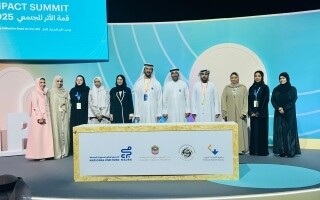
The announcement was made during the Community Impact Summit 2025, its first edition held today in Abu Dhabi, organized by 'Majra' under the theme 'Unifying the Common Good of the Nation'. The event brought together senior officials, CEOs, leaders of corporate social responsibility and sustainability, representatives of government entities, the private sector, non-profit organizations, academics, youth and people of determination, as well as investors and the media.
The summit is held in line with 'Majra's' role as the federal entity responsible for setting the regulatory framework for corporate social responsibility and sustainable impact in the UAE, and as the federal arm supporting sustainable and impactful projects that boost economic empowerment, environmental preservation, and societal prosperity by unifying the efforts of government entities, private companies, and community organizations under the umbrella of corporate social responsibility.
The summit, the first of its kind at the national level, aims to reshape the landscape of the UAE's sustainable impact economy and embed the concept of shared value by uniting the efforts of various sectors in the country to direct societal contributions towards national priority projects, aligning with the leadership's vision and enhancing the UAE's standing in corporate social responsibility and sustainability.
In his opening keynote address, Abdullah bin Touq Al Marri explained that this strategy is based on the 'Strategic Compass Approach,' which represents an integrated federal framework guiding the course of corporate social responsibility and sustainability in the private sector.
The Fund also highlighted the importance of activating its governance mechanisms, represented by the Sustainable Impact Committees, which are chaired by the Chambers of Commerce and Industry in each emirate.
Bin Touq clarified that the strategy is exploring the gradual linking of the Corporate Impact Declaration to the renewal of commercial licenses for private companies, reflecting the state's drive to enhance transparency and embed corporate social responsibility disclosure practices within the private sector, and to support the transition towards an innovative, human-centric economy based on impact measurement, in line with the 'We the UAE 2031' vision and the 2030 Sustainable Development Goals.
He added that the launch of this strategy is a qualitative step to propel the private sector to become a strategic partner in achieving the 2030 Sustainable Development Goals, affirming that the impact economy is a natural extension of the UAE's leadership vision in building a sustainable economy, human-led and society-serving, that balances economic growth with maximizing societal and environmental impact.
Furthermore, the Fund is keen to enhance cooperation with relevant local entities, including the Abu Dhabi Community Authority (Ma'an) and the Dubai Community Foundation (Good).
In turn, Majra's CEO, Sarah Shou, confirmed that the Community Impact Summit 2025 is a platform for building a comprehensive national system for a sustainable impact economy in the UAE, and that Majra is working to turn intentions into tangible results in the lives of individuals and society by directing the private sector's contributions towards an added and sustainable national value, embodied in approved national priority projects, documented through the 'Sustainable Impact Digital Portal' and measured via the 'Corporate Impact Declaration' and the 'Community Impact Medal' in its various categories and levels.
The summit featured four main sessions covering: the comprehensive framework: shaping the general landscape of corporate social responsibility; building the impact economy: partnerships for good and national priority projects; the third session was titled 'Measuring Impact: From Intentions to Credibility,' and the fourth session focused on the future of corporate social responsibility and shared value. The summit's program also included a series of platforms and interactive experiences reflecting the evolution of the national impact system under the leadership of 'Majra'.